


Socialistisk Biblioteks Tidslinje med links til begivenheder og personer i 1776.
Se også Index over personer, organisationer/partier og værker (som bøger, malerier, mm.), steder, begivenheder, mv., der er omtalt på hele Tidslinjen, titler og indhold på emnelisterne osv.
29. januar 1776
Indfødsretten (statsborgerskab) proklameres.
Se:
- Indfødsretten (Denstoredanske)
- Statsborgerskab (Wikipedia.dk)
- Statsborgerskab (Udlændinge- og Integrationsministeriet)
Se også:
Camilla Broe (Wikipedia.org)
Engelsk artikel om første udleverede danske statsborger.
4. juli 1776
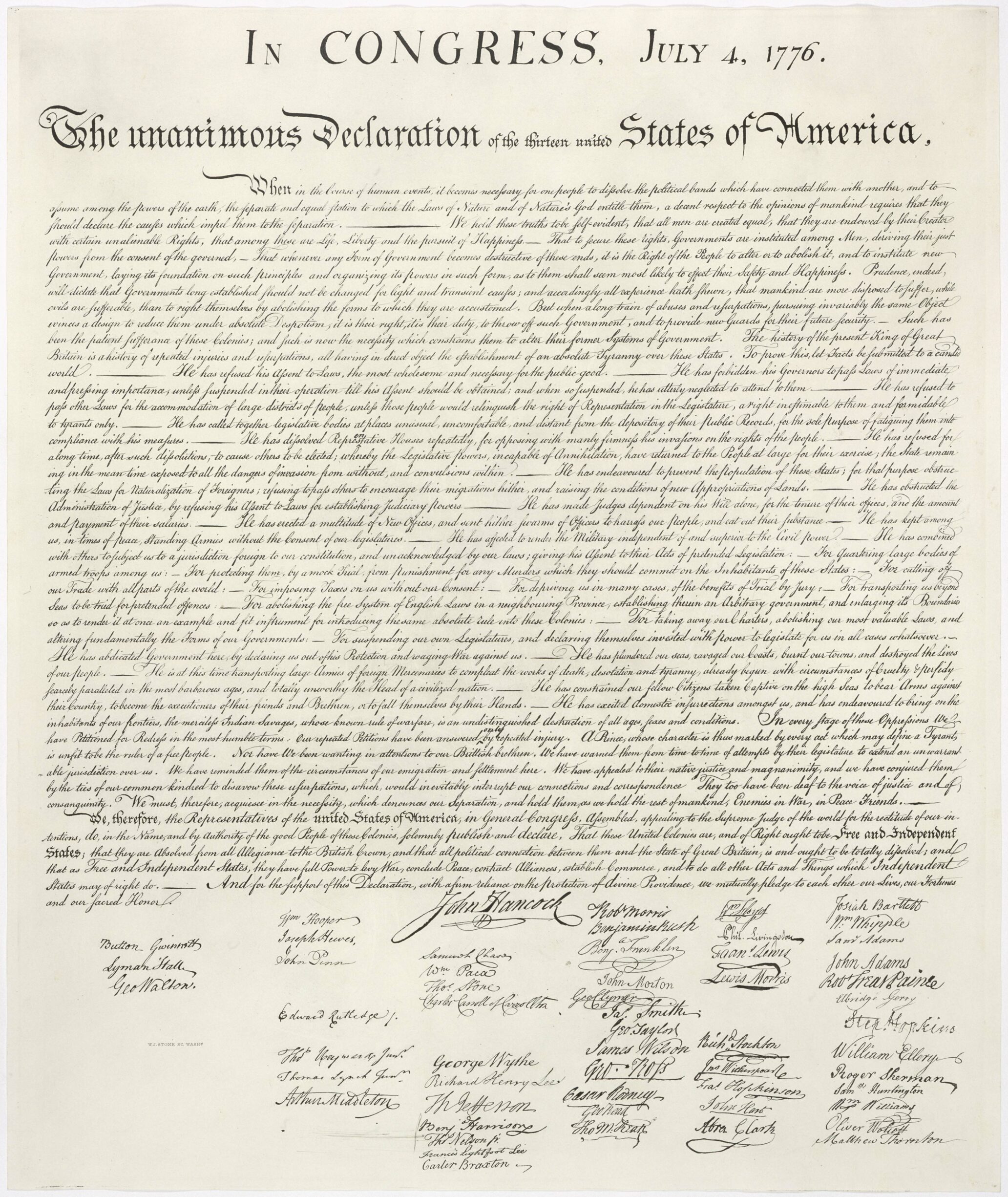
Den (nord-)Amerikanske Uafhængighedserklæring, Declaration of Independence, underskrives.
Links:
- Uafhængighedserklæringen (Denstoredanske)
- USA’s uafhængighedserklæring (Wikipedia.dk). Links til dansk og engelsk tekst.
The two American Revolutions in world history. By David North (World Socialist Web Site, 4 July 2020). “Today marks the 244th anniversary of the public proclamation of the Declaration of Independence, on July 4, 1776, which established the United States of America. It is not only the direct political impact of the document, but, rather, the principles it proclaimed that determined its world historical stature.”
Two hundred forty years since the Declaration of Independence. By Andre Damon (World Socialist Web Site, 4 July 2016). “The victory of the American Revolution provided the ideological and political impetus for the French Revolution and all subsequent democratic, egalitarian and socialist movements.” See also Tom Mackaman: A reply to our critics: In defense of the American Revolution (ibid., 14 July 2016)
The Fourth of July – Revolution and Counter-Revolution in America. By Dan La Botz (New Politics, Blog, July 4, 2017). “The founding fathers—mothers are never mentioned—were by and large wealthy businessmen, rich farmers, or the owners of plantations and slaves.”
Not our Independence Day (Jacobin: Reason in Revolt, 4 July 2016). Interview with William Hogeland: “The Founding Fathers were more interested in limiting democracy than securing and expanding it.”
Slavery and the American Revolution. By Paul Prescod (Against the Current, Issue 178, September-October 2015). Review of Gerald Horne, The Counter-Revolution of 1776: Slave Resistance and the Origins of the United States of America (NYU Press, 2014, 363 p.). “The result is a book that will forever change the way you view the founding of the United States.”
See also review by Jay Moore: A history of a counter-revolution (MR Online, April 2, 2015) + review by Alan Gilbert (The International Marxist-Humanist, July 15, 2015) + Ross Wolfe: 1776 – revolution or counterrevolution?: Recent challenges to the classical narrative (The Charnel-House, July 2, 2014). See the book online at Libcom.
And the longer review article by Fred Schleger: Gerald Horne’s counter-revolution against 1776 (World Socialist Web Site, 17 March 2021). “Horne’s scholarship does not stand up to the slightest scrutiny. Horne’s work is worse than inaccurate: it is, in large measure, a work of fiction. His interpretation of source material is so inaccurate as to be fanciful: quotes are truncated to invert their meaning, sources are misattributed, and even elementary facts are misrepresented—or are just plain wrong.”
America’s revolutionary founding document. By Tom Mackaman (World Socialist Web Site, 4 May 2013). Review of Alexander Tsesis, For Liberty and Equality: The Life and Times of the Declaration of Independence (Oxford University Press, 2012). “Alexander Tsesis’ work deserves a broad audience.”
The Fourth of July, 2004: America’s revolution 228 years on. By Bill Van Auken (World Socialist Web Site, 3 July 2004)
What to the slave is the Fourth of July? (SocialistWorker.org, July 4, 2013). Speech by Frederick Douglass on July 5, 1852.
See also Frederick Douglass: The Meaning of July Fourth for the Negro (Danny Glover Reads Frederick Douglass; Zinn Education project)
Se også:
The apocalypse of settler colonialism. By Gerald Horne (Monthly Review, Vol.69, No.11, April 2018). This article is adapted from Gerald Horne, The Apocalypse of Settler Colonialism: The Roots of Slavery, White Supremacy, and Capitalism in Seventeenth-Century North America and the Caribbean (Monthly Review Press, 2018, 256 p.). See also: Gerald Horne on People’s Republic, talks to Brian Griffith about the 1776 Counter-Revolution (Monthly Review Press, 2018).
Se også på Socialistisk Bibliotek:
- Tidslinjen august 1619, om de første afrikaneres ankomst til Amerika.
- Tidslinjen 16. december 1773, om Boston Teselskabet (Boston Tea Party).
- Tidslinjen 3. september 1783, om den amerikanske uafhængighedskrig.
- Tidslinjen 4. juli 1976, om “fejringen” i Rebild på 200-årsdagen.
- Linkboxen Den Amerikanske Borgerkrig og Abraham Lincoln.


,_by_John_Trumbull.jpg)
